
Is AI Ultrasound Accurate? An Honest Look at What It Can and Can't Do
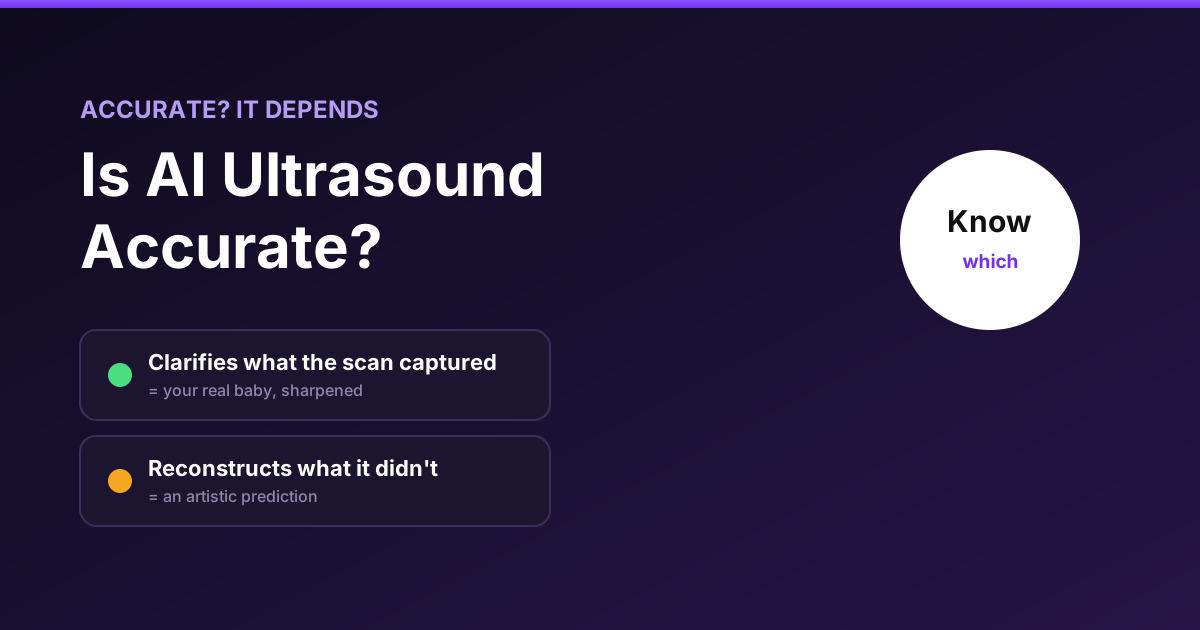
TL;DR — A clearer-looking AI ultrasound image is not proof of accuracy. Any generated output may add, alter, or infer details, especially where the source is soft, shadowed, or hidden. Use it only as a non-diagnostic keepsake, keep the source scan, and prefer a preview with clear disclosure.
If you've searched "is AI ultrasound accurate," you've probably seen two extremes: glossy before/after photos that look too good to be true, and skeptics calling all of it fake. The truth sits in the middle, and it's more useful than either camp. Here's the honest version.
What "accurate" even means for an ultrasound
An ultrasound machine captures real acoustic data about your baby. A 3D/4D render turns that data into a surface image. When that image is soft, grainy, or partly blocked, AI enhancement steps in. The key question is what the AI is doing with the parts you can't see clearly:
- Source-preserving intent — the product may be designed to retain more visible scan structure while changing noise, contrast, or appearance. It is still AI-generated and may infer details.
- More generative intent — the product fills or transforms more of the image. Where the source is hidden, the output is necessarily speculative, not a measurement.
How to assess an output
| Scenario | What to check | What not to assume |
|---|---|---|
| Soft or grainy source | Compare landmarks with the original | Clearer means anatomically accurate |
| Shadow or noise | Check what changed around the region | The system only removed interference |
| Partial obstruction | Look for generated transitions | Hidden details were recovered |
| Fully hidden or turned-away face | Treat the face as speculative | The result predicts actual appearance |
CrystalReveal separates CrystalReveal™ Basic, designed to retain more source structure, from the more generative CrystalReveal™ Bonus. Both outputs may add, alter, or infer details; Bonus may alter or invent more.
The honesty test for any AI ultrasound tool
Before you trust a result, ask:
- Does it separate clarity from reconstruction? A tool that blends them into one "magic" output is hiding the guess.
- Can you preview before paying? If you can judge with your own scan first, the tool has nothing to hide. CrystalReveal gives a free preview and two regenerations.
- Does it make medical claims? It shouldn't. Enhancement is a keepsake, not a diagnostic read.
The honest rule: every output is AI-generated. The amount of visible source structure can differ, but neither result verifies fetal anatomy or future appearance.
So, is it a factual likeness?
No generated result is a guaranteed likeness. A result that retains more of a visible source may feel more recognizable, while a heavily reconstructed result is more speculative. Both should be labeled and treated as keepsakes. We go deeper in Blurry or Obstructed 3D Ultrasound? What AI May Change.
See it with your own scan
Do not take a marketing claim as proof. Upload a 3D/4D image, review a free preview, compare it with the source, and decide whether you want the generated keepsake before paying.
AI enhancement is for keepsake and entertainment purposes, not medical diagnosis. Where a scan is obscured, results can differ from the real baby.