
When Can You See Baby's Face on Ultrasound? A Week-by-Week Guide
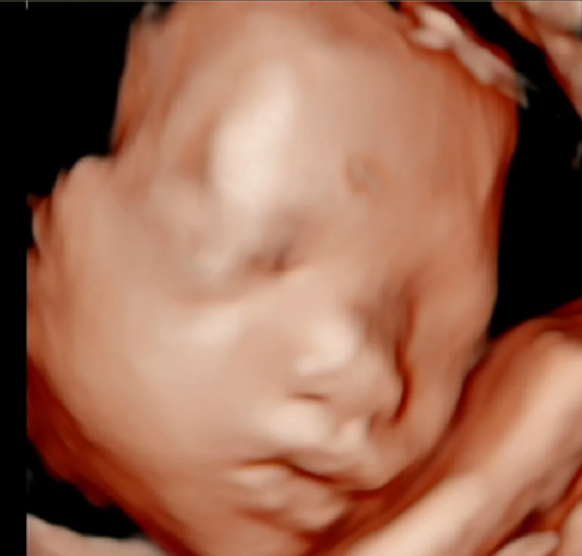
TL;DR — You'll see baby's profile as early as 12 weeks, recognizable features (nose, lips, chin) around 20 weeks on a 2D scan, and a true face you'd recognize in newborn photos between 27 and 32 weeks on a 3D or 4D scan. The "magic window" for 3D photos of baby's face is 27–32 weeks, and there's a real biological reason why.
Pregnancy is full of "when can I" questions. When can I find out the gender? When will I feel kicks? When will my doctor stop calling me "high risk" for being 34?
But the one question we hear most at every Bomee partner studio is: "When can I see my baby's face?"
Here's the honest, week-by-week answer.
Weeks 6–10: The Blueberry Phase
What you'll see: a tiny round shape on the screen, sometimes with a flicker (that's the heartbeat). If you're squinting really hard, you might convince yourself you see a head and a body. Your sonographer will tell you that's the head and body.
What you won't see: anything resembling a face. The facial features haven't formed yet — at 8 weeks, your baby is the size of a raspberry, and the eyes are still positioned on the sides of the head.
Weeks 11–14: First Profile
This is the first scan where your sonographer will say the word "profile." You'll see a curve — the back of the head, the slope of the forehead, the tiny button nose. Maybe a hint of the chin.
At this stage, all babies look pretty similar. The features that make your baby your baby haven't differentiated yet.
If you're doing the NT scan (nuchal translucency) at 12 weeks, you'll get the clearest profile shot of this early window. It's a beautiful first glimpse — but it's not "the face."
Weeks 15–19: Gender Reveal Territory
Most keepsake studios offer gender determination scans starting at 15–16 weeks. The face is starting to look more "baby-like" — eye sockets are visible, lip definition is appearing — but the skin is still very thin and the features look slightly skeletal on a 3D scan.
If you book a 3D scan at 17 weeks, you'll get clear images of the baby, but the face will look more "alien baby" than "Anne Geddes portrait." That's normal. The baby is doing exactly what an 18-week-old baby is supposed to do.
Weeks 20–22: The Anatomy Scan
Your medical anatomy scan is at 20 weeks. This is a 2D scan focused on health, not aesthetics — but you will see your baby's face in profile, and often a few 3D snapshots if your sonographer has time.
At this stage, the face has all its features: eyes, nose, lips, ears, chin. But baby still has almost no subcutaneous fat, which is why the cheeks look hollow and the face looks bony. This is the #1 reason parents leave a 20-week 3D scan a little disappointed — they expected chubby-cheek Instagram baby and got tiny-vampire instead.
It's not the studio's fault. It's just biology.
Weeks 23–26: The Awkward Phase
Babies are gaining weight rapidly now, but most of it is still going into organ development, not facial fat. The face is fuller than at 20 weeks but not yet "filled in."
If you scan in this window, expect:
- A clearer view than at 20 weeks
- Recognizable features
- But still slightly "skeletal" cheeks
- Lots of movement (this is when babies start practicing facial expressions)
This window is actually great for personality shots — you'll catch yawns, frowns, tongue-pokes, hiccups. Just don't expect the portrait-perfect chubby-cheek shot yet.
Weeks 27–32: The Magic Window
This is the window. The reason every experienced sonographer pushes you to book between week 27 and week 32 is rooted in three biological facts:
- Subcutaneous fat has finally developed enough to give baby those round cheeks
- Amniotic fluid volume is still high enough to give a clear "view" through to the face
- Baby is still small enough to fit comfortably in frame and move around
If you've ever seen a 3D ultrasound that made you gasp on Instagram, it was almost certainly taken in this window.
We wrote a deeper breakdown of why this window is so magical in our [Magic Window guide](/insights/the-magic-window-when-is-the-absolute-best-time-to-get-3d-4d-ultrasound-photos-of-your-baby-s-fac).
Weeks 33–37: Getting Crowded
After week 33, baby is gaining about half a pound per week — which is wonderful for delivery but increasingly difficult for facial imaging. Two things happen:
- Less amniotic fluid relative to baby size — fluid is the "window" the ultrasound looks through. Less window means more interference.
- Baby gets stuck in position — there's less room to move, so if she's facing your spine, you may not be able to get a face shot at all.
That said, this is the perfect window for the "final look" mini-session — short, sweet, and the chubbiest your baby will ever look in utero.
Weeks 38–40: Birth Window
Honestly, most studios won't book elective scans past week 37 — partly because the imaging quality drops, partly because clients are too uncomfortable for a 30-minute session.
But if you do scan late, the upside is that your baby's face now looks essentially the same as it will at birth. The proportions are set, the features are fully developed. The downside is that getting a clear angle is largely a matter of luck.
What about the AI portrait technology?
Here's something new in 2026. Even at the "ideal" 27–32 week window, the 3D ultrasound is still showing you a slightly distorted view of your baby because of fluid scatter, lighting, and the physics of ultrasound itself.
[BabyView AI](/babyview-ai) — the technology now available at hundreds of partner studios — takes the raw 3D scan data and runs it through a predictive AI engine that compensates for those distortions. The output is a hyper-realistic portrait that's been described by parents as "the photo I'll show at the baby shower" rather than "the ultrasound print I'll put in a drawer."
It's not a filter. It's a prediction based on the actual scan data — meaning when your baby is born, the AI portrait often looks shockingly similar. We've documented this in our [newborn comparison post](/insights/the-ultimate-keepsake-comparing-newborn-photos-to-their-3d-4d-ultrasound-pictures).
The bottom line for booking
If your goal is "I want to see what my baby looks like":
- Book between 27 and 32 weeks
- Ask the studio if they offer AI portrait technology
- Hydrate for 3–4 days before your appointment
- Eat a small sugar snack 15–20 minutes before
If your goal is "I just want to know the gender":
- Book between 15 and 18 weeks
- Don't expect a face shot
If your goal is "one last peek before delivery":
- Book between 34 and 36 weeks
- Expect a short session and lower image clarity
Ready to meet your baby?
Download the [Bomee App](/bomee-app) to track your pregnancy week by week, get reminders for the optimal scanning windows, and store every scan in one place — for free. Pair it with a visit to a Bomee-affiliated studio and you'll have your scans on your phone before you leave the building.