
Case Study · Bomee Core + Momitalk
How Reveal Ultrasound Cut USB Delivery to Zero and Lifted Revisit Bookings 31% in Six Months
Reveal Ultrasound replaced burned discs and reply-all email threads with barcode-driven instant delivery. Six months later, USB SKU spend is gone, the studio's average response window dropped from 18 hours to under 30 seconds, and revisit bookings climbed 31%.
At a Glance
+31%
Revisit bookings, six months post-deploy
~11 hrs
Admin time reclaimed per week
100%
USB-free media delivery
4.9★
Sustained Google review average (n=240+)
Based on owner-reported figures over a six-month period (Oct 2025 – Mar 2026). Revisit booking lift compares the six months pre-deploy to the six months post-deploy. Review average pulled from the studio's public Google Business Profile.
Background
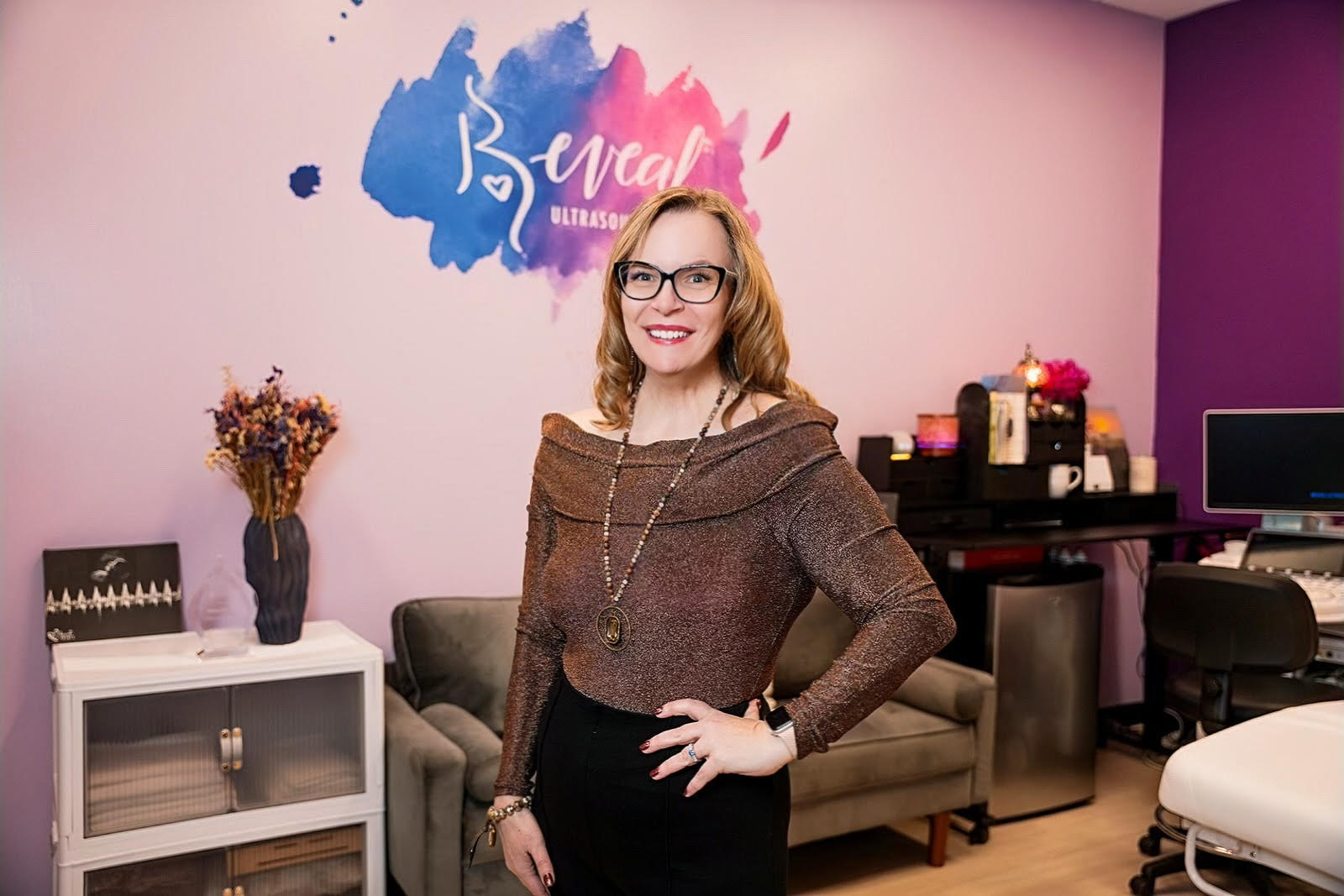
Reveal Ultrasound is a single-room elective imaging studio operating in the United States. The owner, a former clinical OB sonographer with more than a decade of hospital experience, opened the studio with a single thesis: the moment a parent first meets their baby should not feel like a billing appointment.
The studio runs roughly 95 to 130 sessions per month, weighted heavily toward the 26 to 29 week 3D/4D "magic window." Sessions average 35 minutes and almost always include at least one extra family member in the room — partners, siblings, grandparents. The owner runs the scanner herself on a GE Voluson E8 platform, captures media in the studio's signature warm-tone preset, and finishes by handing the parents a tangible memento. Until late 2025, that "tangible memento" was a printed photo strip plus a branded USB drive.
On paper the USB was harmless. In practice, it had become the single biggest source of operational friction in the studio.
The Problem: A 12-Step USB Handoff
Before Bomee, the post-session workflow at Reveal Ultrasound was a twelve-step process that began the moment the parents zipped up their jackets and ended, on a good week, twenty hours later in someone else's inbox.
The scanner exported a session bundle — typically eighteen to thirty-five JPEG stills and four to nine MP4 clips, totaling between 480 MB and 1.4 GB — onto a flash drive over a slow USB 2.0 port. The owner manually deleted screenshots that didn't make the cut, dragged the curated set onto a labeled branded USB, ejected the drive, walked it out to the waiting area, and hand-delivered it with a thank-you note.
That part actually worked. What didn't work was everything that came next.
Roughly one in six families called or emailed within forty-eight hours with a follow-up issue. The most common ones were predictable: "My MacBook doesn't read the USB." "My phone doesn't have a USB-C port." "My mom's TV says the file format isn't supported." "I plugged it in and it froze." Each one consumed fifteen to forty minutes of owner time — exporting a fresh copy, zipping the bundle, attempting an email transfer that failed at 25 MB, switching to WeTransfer, and chasing the parent to confirm receipt.
The math compounded. Across about 110 sessions per month, the studio was burning an estimated 11.5 hours a week on delivery support alone. Worse, the lag between scan and "received and shared" was killing the studio's natural marketing engine. When the parents finally posted the gallery, they were three to five days past peak excitement. The hashtag tag rate dropped. Referrals from in-laws and group chats — historically Reveal's #1 acquisition channel — softened.
"I was watching the magic of the studio leak out through a USB port," the owner said.
The Solution: Bomee Core + Momitalk
The studio deployed Bomee Core in October 2025. Installation took the owner one afternoon between sessions. The hardware — a palm-sized mini-PC — sits behind the Voluson on a Velcro mount, draws HDMI capture from the scanner's pass-through port via a single 6-foot cable, and runs the Bomee Core agent on the studio's dedicated non-clinical network segment.
The new workflow is almost embarrassing in how short it is. At the end of a session, the owner scans a barcode on the parent's intake sheet. The capture session terminates on the device. The studio's curated stills and clips upload to the parent's Momitalk feed in under thirty seconds on the studio's 200 Mbps fiber. The parents leave the room with the full gallery already on their phones. By the time they reach their car, grandparents two thousand miles away are watching the clips.
The owner also enabled two features that, in retrospect, are doing more work than the core delivery itself:
- Studio-branded gallery. The Momitalk feed carries the Reveal Ultrasound mark and a single tasteful CTA back to the booking page. Every share the parents do — and they do many — carries that mark with it.
- Free do-over flagging. If the baby refuses to cooperate, the owner flags the session for a complimentary re-scan directly from the Core dashboard. The parent receives the offer in-app rather than via an email that may never get opened.
The USB drive stockpile — about 80 unused units at deploy time — was retired. The studio stopped ordering refills the following month.

The Results
Six months in, the studio's owner-reported numbers tell a consistent story.
- Revisit bookings up 31%. Families coming back for a second 3D/4D pass — usually around 32 to 34 weeks — jumped from roughly 14% of clients to 19%. The studio attributes this almost entirely to the in-app re-booking nudge that appears in Momitalk three days after delivery.
- 11.5 hours of weekly admin reclaimed. Time previously spent on resend requests, file-format troubleshooting, and "did you get the link?" follow-ups effectively went to zero. The owner reallocated most of it to expanding session slots on Friday and Saturday — directly raising studio capacity.
- Zero USB SKUs purchased since deploy. At a unit cost of about $3.20, plus packaging and labels, the line item simply disappeared.
- Review velocity nearly tripled. The studio went from averaging two to three new Google reviews per month to seven to nine — driven, the owner believes, by the post-delivery review prompt that fires while excitement is still peaking.
- Referral tag rate up sharply. The studio's Instagram tag count grew from roughly 40 per month to 110+, with the bulk coming inside the first 24 hours post-session — exactly the window USB delivery had been missing.
None of these moves are flashy in isolation. Stacked, they shifted the studio from "running hard to keep up" to "running with margin to grow."
"Oh, Momitalk changed my life. And my clients' too. Gone are the days of burning USBs and praying someone remembered to bring one home to Grandma. Now, by the time they buckle their seatbelts, their photos and videos are already on their phone. Ready to be shared, screenshotted, and adored! The 'wow' moment used to happen in my studio. Now it happens again in the parking lot, and again at dinner when they show off their baby's little pout. It's instant joy, zero tech drama, and a total workflow upgrade for me."
— Owner, Reveal Ultrasound
Operational Takeaways
- USB delivery is rarely "free" — the real cost is in the support tail it generates and the marketing window it misses.
- Single-operator studios benefit disproportionately from instant delivery, because every reclaimed admin hour converts directly into scan capacity.
- The right time to nudge for a revisit booking is inside the gallery, three days post-session — not in an email a week later.
- A branded Momitalk feed turns every grandparent share into a low-effort, high-trust acquisition channel.
See how Bomee can transform your studio.
Most studios deploy Bomee Core in a single afternoon. Talk to our team about a setup that matches your scanner, your volume, and your room.
Talk to Bomee